Almonty Korea Moly
Receive project alerts from Almonty Korea Moly
Latest News
Almonty Appoints Veteran Financial Executive Guillaume Wiesenbach de Lamaziere, CFA as Chief Development Officer
Almonty today announced the appointment of Guillaume Wiesenbach de Lamaziere, CFA as Chief Development Officer to spearhead key corporate development strategy and execution.
Almonty Appoints Decorated U.S. Army Brigadier General (Retired) Steven L. Allen as Chief Operating Officer
Almonty today announced the appointment of Brigadier General (Retired) Steven L. Allen as Chief Operating Officer to optimize tungsten deliveries at the Company’s Sangdong and Panasqueira Mines.
Almonty Commences Legal Proceedings Against Pure Tungsten Inc. Resulting from False and Misleading Statements
Almonty today announced that it has filed a Notice of Application in the Ontario Superior Court of Justice against Pure Tungsten Inc.
Project History
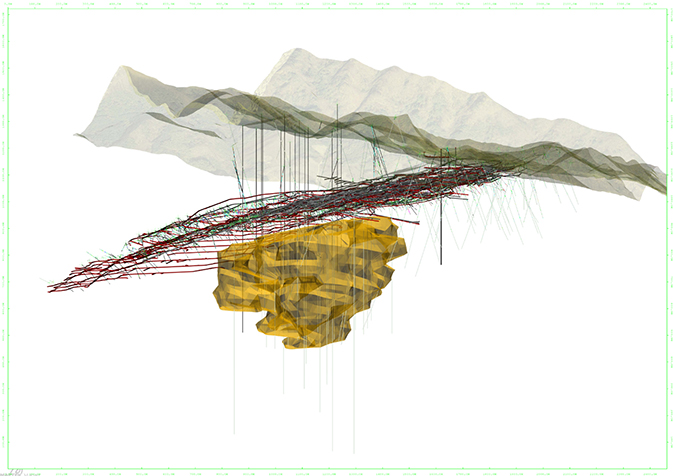
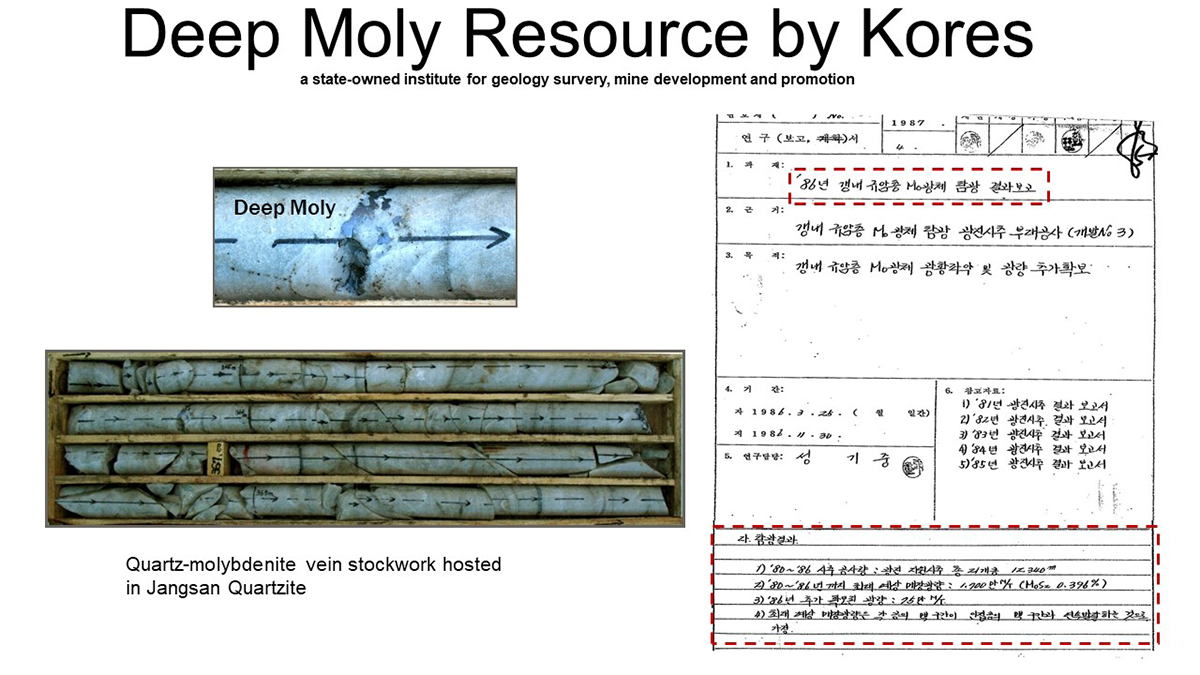
Almonty Korea Moly (AKM) Project is located on the Almonty Korea Tungsten property close to Sangdong Village and about 190 km southeast of Seoul and 50 km from Taebaek. The AKM target is a large molybdenite-quartz vein stockwork deposit identified by KTMC in 1980-87 in the Sangdong area that is known as the Deep Moly Deposit. The Deep Moly Deposit has a similar origin but is completely separated from the tungsten mine of Sangdong, physically and geologically.
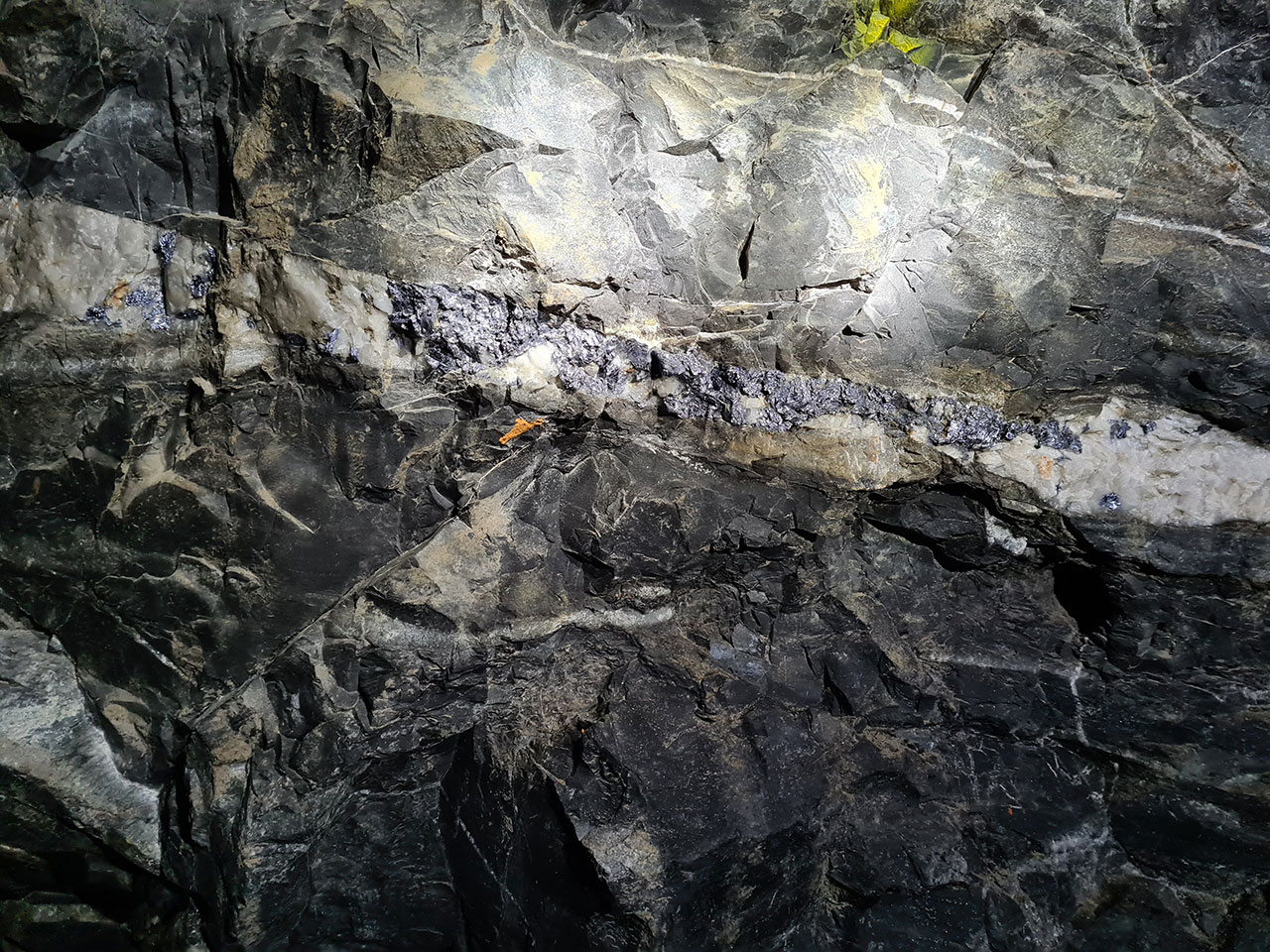
This deposit is positioned in a quartzite unit (Jangsang Quartzites) located below the WO3 Sangdong mine, between the schists (Myobong Slate Formation) and the deeper intrusive rock (Granite), with a vertical thickness of up to approximately 400m below the skarn horizons. The molybdenite mineralization is contained in a subvertical quartz vein “stockwork”. This vein system is located inside the quartzite (Jangsang Quartzite). More exploration work is planned to obtain a greater definition of the significant amount of tonnage and higher-grade averages of all this mineralized quartzite.
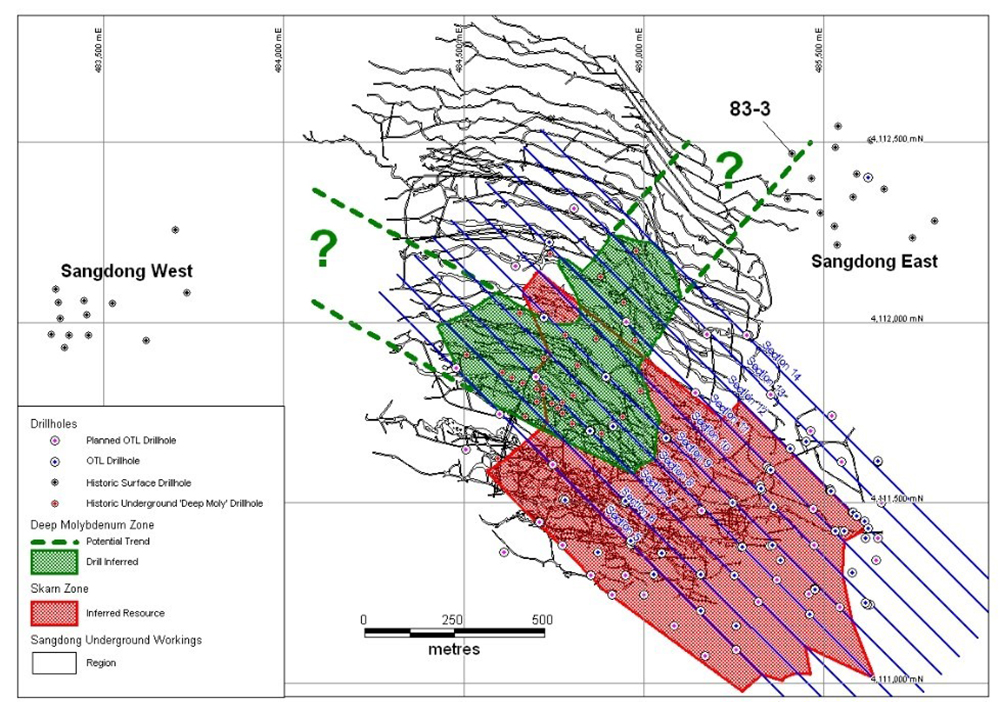
Future exploration work will be conducted to confirm the geometry and origin of this structure. Some of our geologists believe that this is more than simple stockwork, that it could also have worked as a pipe, allowing the circulation of the metal rich fluids to reach the schists, namely to the calcsilicate levels/skarns existing above the quartzite, thus inducing the WO3 mineralization of the Sangdong Mine. The studies done by KTMC (22 vertical holes corresponding to 12,390m core drilling) has conduced a preliminary resource estimation of generally a high grade “Prospective Ore Reserve” of 16.3Mt grading 0.40% MoS2 or a lower grade global resource of 120Mt grading 0.13% MoS2.
Read more »

More recently an external study by KTMC and OTL on the drill holes (37 drill holes) was developed into a Block Model and it pointed to the need of acquiring more information to determine more accurate numbers for tonnes and grades.
The previous work and/or studies completed on the Jangsan quartzites, found that this Deep Moly Deposit was not included in any of the 43/101 resource/reserve calculations of the tungsten Sangdong mine.
We have identified the Deep Moly location and we recognize that further knowledge of this structure is needed. This is expected to be acquired during the early WO3 Sangdong mine exploitation.
If the exploration work confirms the anticipated results, we would most likely commence mining the Mo content from the existing veins in the Jangsang quartzites.
The Deep Moly zone is still open from the NE to the NW. The potential of this deposit is possibly one of the largest Mo deposits in SE Asia. The potential of this Mo zone is enormous and during the life of Almonty Korea Tungsten (Sangdong Mine), more exploration work over this large target will be required.
Potential
Deep Moly can add mining potential to the Sangdong region, as it can be a distinctively new deposit that can potentially be mined.

The proxmity to the Sangdong Tungsten Mine offers substantial synergies in infrastructure, logistics, and operational efficiencies, potentially allowing for the shared use of access roads, power supply, water resources, and processing facilities.
Molybdenum has been recognized as one of the six cross-cutting critical minerals by the World Bank in 2020, indicating its essential role in the transition towards green energy technologies. Molybdenum is a key component in wind energy technologies, with the highest usage per megawatt (MW) of energy compared to coal and nuclear. As wind energy continues to expand, with an expected growth rate of around 9.5% until 2030 and beyond, the demand for molybdenum will be significantly influenced by the wind energy sector.
| Image | Title | Content | Link |
|---|---|---|---|
| NI 43-101 Technical Report on the Mineral Resources of the Sangdong Molybdenum Stockwork Project, South Korea 2022 | September 22, 2025 | 3.1MB |
Almonty Live Projects
Trusted and experienced operations in conflict-free regions by diversified tungsten specialists. The company’s focus remains on past producing mines, operations that are on care and maintenance, tailings stockpiles and other situations where near-term production and positive cash flow can be achieved.